

The goodness of the RPA became evident, in different ways and in a short time; If you are looking to pave the way for the digital transformation of your company and want to achieve sustained growth through greater efficiency, surely what you need is to include automation as a strategy for the automation of your processes. lograr un crecimiento sostenido a través de una mayor eficiencia, seguramente lo que necesita es incluir la automatización como estrategia para la automatización de sus procesos.

If you are interested in adding RPA to your contacting company.
How and where to start?
Although the adoption of this type of technologies can be imagined as a complex challenge, the good news is that, despite not having great resources, it is totally possible and viable to align the different business units within the company, with them professionals engaged in automation tasks and, thus, generating a successful project.
However, we understand that from a strategic approach, the successful implementation of RPA in a wide range will require an intelligent approach, which focuses on the use of the appropriate, powerful and safe technologies to satisfy the entire staff involved in the project.
In this regard, we must emphasize that if there is no single recipe that allows the implementation to be systematized, if it is suggested to go through an initial exploratory phase where the most simple, repetitive and tedious processes must be identified.
The product of this initial phase should be immediate results that give visibility and confidence to the team, to the employees involved and to the organization in general.
In addition, it should be ready to go through a subsequent consolidation phase, where it is possible to coordinate and integrate multiple processes across different areas of the organization, interconnecting different business applications.
What aspects to consider to make the best decisions to implement RPA:

- Understand exactly what RPA is about and its possibilities.
- Identify “candidate processes” as automation opportunities.
- Choose the provider the appropriate partner who can provide solutions and support at all times.
- Carry out a concrete concept study to visualize the potential of the solution without focusing on the measurement of the immediate return of the investment.
- Measuring the results and documenting the entire process, which will help a lot in future modifications.
- Select the next case and repeat the exhaustive documentation process prior to development.
Essential Lo in RPA

When choosing among the infinity of solutions available in the field of robotic process automation, it is necessary to have the capacity to manage the efficiently the eventual increases in the workload and possible expansions.
Finally, we see another extremely interesting aspect within organizations that is the cascading effect of automation, where a cultural change is generated from within, allowing doors to be opened to identify problems of inefficiency of scale, which lead to the discovery of new candidate processes to be automated.
For all these attributes, let us maintain that RPA is consolidating itself in many companies around the world, but it is still on the way to reaching its maximum splendor.
To guarantee the success of the implementation of an RPA project in any company and obtain tangible benefits, it is necessary to put into practice a series of principles, which require the commitment of the members of the company to promote a management of the change in the organizational culture.
We commit to the organizational strategy

The first is to prepare the organization. For him, we must think of RPA as part of a strategy, rather than as an independent solution that can be implemented in a given department. Therefore, it requires an initial planning, an organizational structure that supports it, a platform or technology that allows its deployment, a trusted partner to achieve success and, most importantly, a change management strategy for the entire company.
After we observe the candidate processes

When implementing RPA, the first thing to do is to study the chosen process with all the details. We must evaluate it from point to point: what is it really done and why, how data is changed and how it is used throughout the organization. Analyzing the process optimizes its efficiency, even before automating it.
We need a design focused on automation
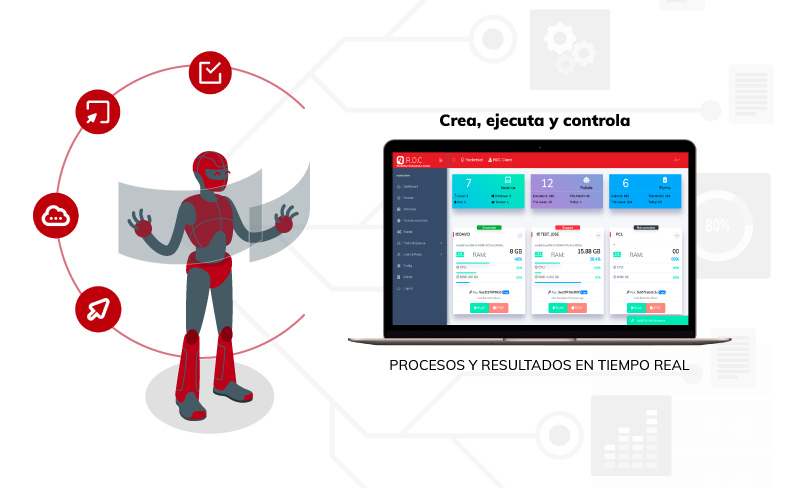
The automation can be applied to any process, but the automation design of each one can be very different. Therefore, when it comes to designing automation, there are multiple factors to consider:
- Evaluate the stability of the process
- Define the size and scale of delivery
- Count the number of possible points of failure or error
- Evaluate the opportunity to merge or separate
- Calculate the deployment time
- Contemplate the number of exceptional scenarios
Finally, it is also important to focus on maximizing ROI. We must seek a balance point in the automation of a process and avoid investing in bots that are underused.
Technological selection
Currently, many technology providers are appearing that implement RPA and that use different platforms. Choosing the appropriate platform is one of the key steps in the success of the implementation project of a robotic process automation solution. Rocketbot presents ease of use, architecture, stability, support and accommodation requirements are some of the key areas in which this tool stands out.
On the other hand, it is also important to analyze the design of the company and its configuration architecture. The consultants of the chosen platform will be in charge of this, to understand if there are dependencies, limitations and exceptions, key to have in account. Siempre con el fin to avoid surprises later.
Change management
The implementation of an RPA solution requires a very clear and effective change management methodology. A process scenario in constant evolution guarantees multiple changes, which will start from the different systems, applications, processes, policies and data involved in automation. So, in order to approach a project with these characteristics without affecting the normal functioning of the organization, it is necessary to anticipate and design its impact, quantifying it to the extent possible, before finalizing the automation design.
Por isso, a tarea clave de cualquier implementação de RPA garantirá que os robôs sejam gerenciados tanto em conhecimento como em habilidades, como em sua forma de execução.

 EN
EN  ES
ES  PT
PT